
New to Quilting? Start Here.
Welcome. I'm so glad you found your way here.
If you're feeling a overwhelmed by where to begin, that's completely normal. I get it! Quilting has a lot of moving parts (literally and figuratively), and it's easy to find yourself down a rabbit hole just by searching "how to quilt" on Google. Throw in Chatgpt and you’ll be inundated with information. This page is designed to cut through the noise and give you a clear, step-by-step path from your very first block to your very first finished quilt.
I'm Tiffany Bynum, the pattern designer and educator behind Straight Stitching. I started quilting in 2022 with no formal training, so I know exactly what it feels like to be where you are right now. Everything on this page is built around what I wish I had when I started.
Let's get you quilting.
Step 1: Understand the Basics
Before you pick up a rotary cutter, it will be helpful to understand a few basis concepts. These aren't complicated, but knowing them early will save you a lot of frustration.
What is a quilt block? A quilt block is the repeating unit that most quilts are built from. Think of it as one tile in a larger pattern. Learn one block well, and you can make an entire quilt out of it.
What is a quarter-inch seam? In quilting, almost everything is sewn with a quarter-inch seam allowance. Getting this right makes the difference between blocks that line up and blocks that don't. It's the single most important habit to build early.
What is pressing? Pressing (not ironing - there's a difference) sets your seams and keeps your blocks flat and accurate. It matters more than most beginners realize.
Step 2: Learn Your First Quilt Blocks
These are the traditional blocks I recommend for beginners. They teach you the core skills of quilting and they're fun to make.
Nine Patch The most beginner-friendly block in traditional quilting. Nine squares sewn together. Simple, versatile, and the foundation for dozens of more complex designs. Read the Nine Patch tutorial →
Rail Fence Three strips. One block. A fantastic introduction to strip piecing, which is one of the most useful techniques in quilting. Read the Rail Fence tutorial →
Log Cabin A classic for good reason. The Log Cabin block teaches you to work from the center outward and gives you a real feel for how quilt design decisions affect the finished look. Read the Log Cabin tutorial →
Churn Dash Your first step into slightly more complex piecing. This one combines squares, rectangles, and half-square triangles which makes it the perfect bridge block before you move into more difficult techniques. Read the Churn Dash tutorial →
Half-Square Triangles (HSTs) HSTs are probably the most-used unit in traditional quilting. Once you know how to make them accurately, a huge range of patterns becomes accessible to you. I've put together a complete guide that covers multiple methods, a sizing formula, and my honest recommendation for beginners. Read: How to Make Half-Square Triangles →
Flying Geese Flying geese are the second technique I'd recommend learning. They show up in everything from sampler quilts to complex star patterns. My tutorial covers the most beginner-friendly method plus the fix I always use to get the sizing right. Read: How to Make Flying Geese →
Want a reference you can keep at your cutting table? Download my free cheat sheets. They're quick-reference guides for HSTs, flying geese, and more with formulas, common sizes, and tips.
Step 3: Try Your First Pattern
When you're ready to put it all together, here are the patterns I recommend for beginners. Each one is designed to be approachable from the start, with clear written instructions and detailed diagrams.
Sew Sampler - The best starting point in the Straight Stitching shop. This sampler-style pattern introduces you to multiple traditional block types in a single project. It’s perfect for practicing HSTs and basic block construction all at once. Shop Sew Sampler →
Geometric Glee - My very first pattern, and I designed it to be as approachable as possible. It's a larger quilt built from squares, rectangles, and just a handful of half-square triangles. It’s a great choice if you're building confidence with basic shapes before moving into more complex techniques. Shop Geometric Glee →
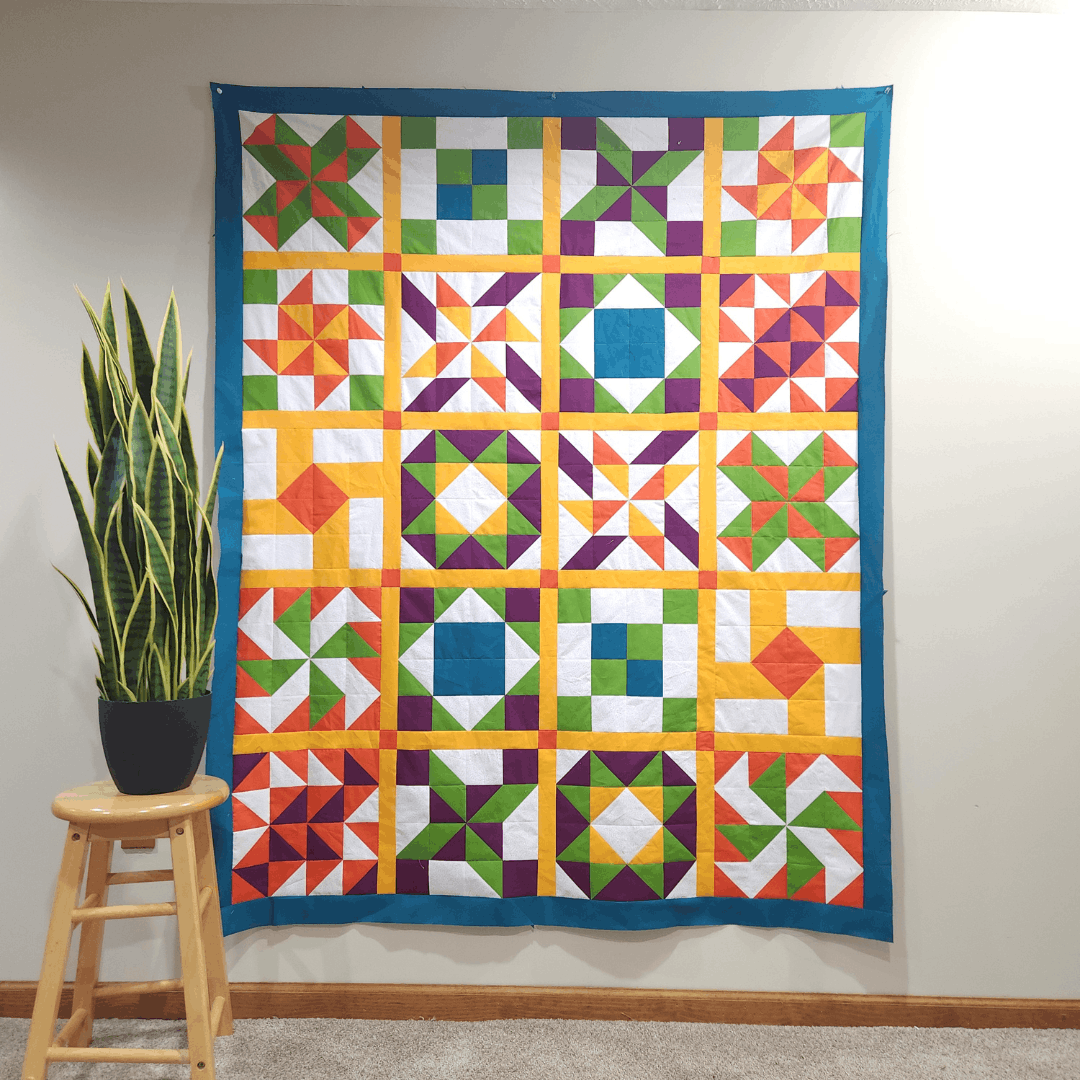
The best way to learn quilting is to actually make a quilt, and Sew Sampler gives you ten reasons to do exactly that. Ten classic blocks, all built from half square triangles and squares, come together in one throw that teaches you the real foundations of piecing while you work.
Pattern Overview
Sew Sampler was designed for the beginner who wants to build a real block vocabulary from the start. Every block in this sampler uses just two units — half square triangles and squares — which means you strengthen the same core skills across ten different layouts. By the time the quilt is finished, those fundamentals are yours to keep. Fabric shown: Pure Solids collection by Art Gallery Fabrics.
What You'll Make
Throw: 56½" × 70"
Block size: 12" finished
The 10 Blocks
Flying-X
Susannah
Uneven 9 Patch
Mosaic 18
Mosaic 19
Art Square
Clay's Choice
Old Tippecanoe
Star Puzzle
Yankee Puzzle
Visualize Your Quilt
Want to try different colorways before you cut? Try the Sew Sampler mockup tool on PreQuilt.
Inside the PDF
11-page instant-download PDF
Instructions for all 10 classic blocks
Full-color cutting charts
Step-by-step illustrated instructions with diagrams
Tips for accurate half square triangle construction and block assembly
Skills You'll Practice
Half square triangle piecing
Accurate square cutting and placement
Block-by-block assembly
Seam pressing and matching
Quilt layout and final assembly
This Pattern Is Perfect For
True beginners who want to learn by making something real. If you are just starting your quilting journey and want a pattern that builds your skills one block at a time, Sew Sampler is the right place to start. Ten blocks, two units, one quilt you will actually be proud to finish.
This is a digital PDF pattern — no physical items will be shipped. Your download link will be delivered instantly via email after purchase. A free PDF reader such as Adobe Acrobat Reader is needed to open and print your pattern.
Due to the digital nature of this product, all sales are final. Please reach out at tiffany@straightstitching.com with any questions before purchasing.
© Straight Stitching, LLC. This pattern is licensed for personal use. Finished quilts made from this pattern may be sold; please credit Straight Stitching. Do not copy, share, or resell the pattern file itself.
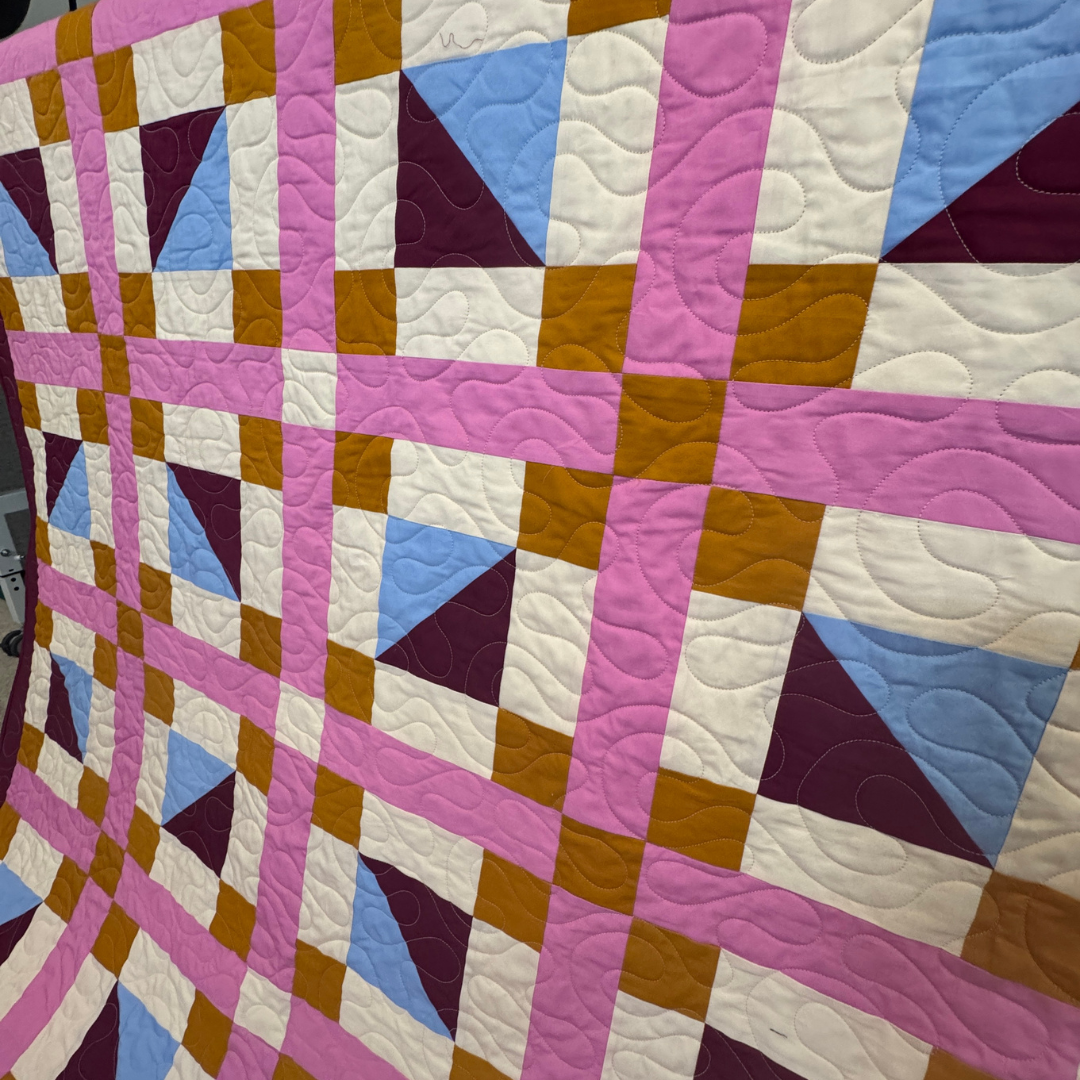
Clean lines and bold shapes have a way of making a quilt feel confident - and Geometric Glee delivers exactly that. Built from squares, rectangles, and half square triangles, this is the kind of design that proves you don't need complexity to make something striking.
Pattern Overview
Geometric Glee was the very first pattern I designed, and the simplicity behind it is exactly the point. Large, graphic blocks come together in a layout that is direct to piece and bold on a bed or a couch. The result is a quilt that looks intentional and polished - because good geometry does that naturally. At 77" × 77", it finishes as a generous throw you'll actually reach for.
What You'll Make
Throw: 77" × 77"
Block size: 22½" finished
Visualize Your Quilt
Want to try different colorways before you cut? Try the Geometric Glee mockup tool on PreQuilt.
Inside the PDF
12-page instant-download PDF
Full-color cutting charts
Step-by-step illustrated instructions with diagrams
Tips for accurate half square triangle construction
Layout diagram
Skills You'll Practice
Half square triangle (HST) piecing
Cutting and piecing rectangles accurately
Squaring up large blocks
Pressing for flat, accurate seams
This Pattern Is Perfect For
Beginner quilters who are ready to make a full-size quilt without being overwhelmed. The blocks are large, the piecing is clear, and the geometric layout is genuinely satisfying to build from start to finish.
This is a digital PDF pattern - no physical items will be shipped. Your download link will be delivered instantly via email after purchase. A free PDF reader such as Adobe Acrobat Reader is needed to open and print your pattern.
Due to the digital nature of this product, all sales are final. Please reach out at tiffany@straightstitching.com with any questions before purchasing.
© Straight Stitching, LLC. This pattern is licensed for personal use. Finished quilts made from this pattern may be sold; please credit Straight Stitching. Do not copy, share, or resell the pattern file itself.
Step 4: Watch on YouTube
If you're a visual learner, the Straight Stitching YouTube channel is the best place to see these techniques in action. I walk through the steps on camera so you can follow along at your own pace, pause, rewind, and sew alongside me.
Watch on YouTube: @StraightStitchingQuilts
I'd also recommend the Mosaics & More Block-of-the-Month series, which is ongoing throughout 2026. Each month covers a new block with full video instruction. It's a great way to build your skills gradually over time.
Step 5: Stay Connected
The best way to keep learning is to have a little encouragement showing up regularly. The Straight Stitching newsletter goes out consistently with technique tips, new patterns, and behind-the-seams updates from the studio.
You're More Ready Than You Think
Starting quilting can feel intimidating, but here's what I know after teaching beginners: the hardest part is the first cut. Once you start, the skills build faster than you expect.
Every quilt in the Straight Stitching shop was designed with you in mind. Every tutorial on this blog was written to make the technique actually make sense. And I'm here if you have questions.
Now go make something.